Air Source Heat Pump Installers
An air source heat pump offers an alternative method of heating your property. Using it will enable you to generate your own renewable heat and potentially reduce your energy bills.
The heat pump delivers heat at lower temperatures than gas and oil boilers, so you’ll have to run it for longer periods to heat your home comfortably. In order for the heat generated by the pump to reach a comfortable level, you must ensure your home is well insulated – otherwise, the heat may escape more easily.
You might save more money on your heating bills with a heat pump, but that depends on the type of system you’re replacing, such as electric storage heaters, oil, LPG (liquefied petroleum gas) or coal, as well as the efficiency of your heat pump, and whether or not you have a heat pump tariff. Our air source heat pump installers will be able to advise.
How Does an Air Source Heat Pump Work?
The air source heat pump uses a compressor to boost the heat from outside air into a higher temperature. The heat is then transferred to your property’s heating system. Basically, they work the same way as refrigerators but in reverse.
At a low temperature, the liquid refrigerant in an air source heat pump absorbs the heat from the outside air. In order to raise the temperature of the liquid, the pump compresses the liquid using electricity. It then condenses back into a liquid in order to release the stored heat. The heat is transferred to your radiators or underfloor heating. The rest can be stored in your hot water cylinder.
How is a Heat Pump Installed?
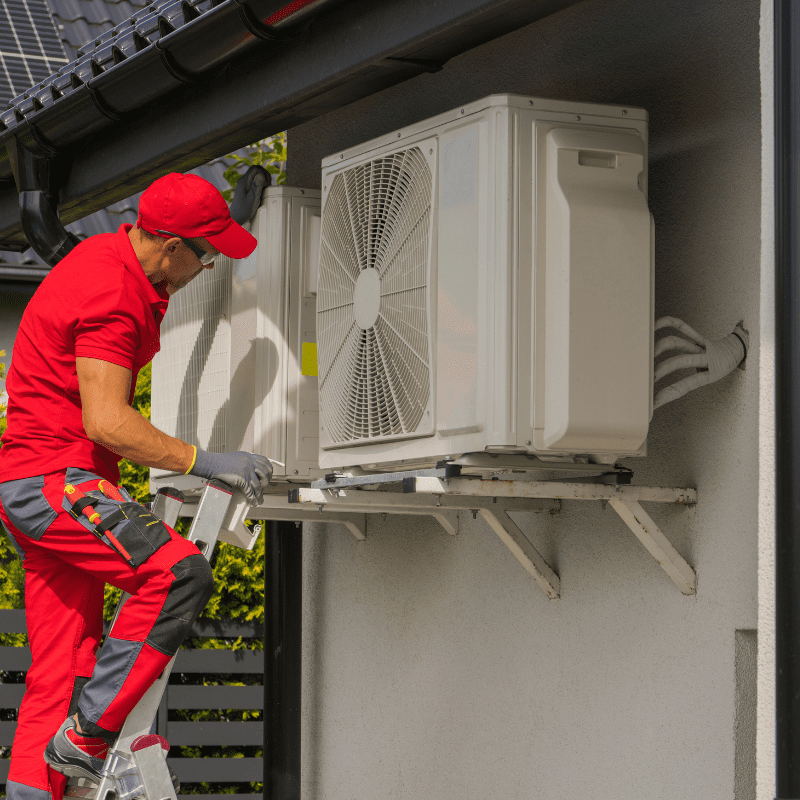
A heat pump that uses air as its source is typically mounted outdoors at the side or back of a property. There needs to be plenty of space around them so air can circulate around them.
Most properties in the UK have monoblock systems, which place the external unit on or next to an exterior wall. It generates hot water and sends it into your property. You don’t need more than that if you only want to heat your property. You will need an indoor hot-water storage cylinder if you want the heat pump to provide your hot water as well.
When the external unit and preoprty are quite a distance apart, a split system can be used instead. It consists of an external unit and an internal heat exchanger about the size of a small boiler. If you just want it for heating, then no hot-water cylinder is needed, but if you want it to provide hot water, you’ll need one as well.
If you decide to use a heat pump only for heating, no hot-water storage cylinder is needed. It is possible to use separate methods for hot water (such as electric showers, instant hot water taps, or instantaneous water heaters).
The installation of air source heat pumps is less disruptive than that of ground source heat pumps since no digging is required in the garden.